The short answer
- Best overall
- November to March
- Andaman coast
- November to April
- Gulf islands
- January to August
- Avoid in the north
- Late February to April (smoke)
Thailand doesn't have one season, it has three. The north and Bangkok follow a simple pattern: cool and dry November to February, very hot March to May, rainy June to October. The two coasts are where most people go wrong: the Andaman Sea and the Gulf of Thailand catch different monsoons, so when one is wet the other is usually dry.
That means there's somewhere good in Thailand in every month. The map below shows where, and our month by month guides go into each month in detail.
Where's good each month
Tap a month to see conditions in each region. Green is good, amber mixed, and red wet, rough or smoky.
Choose your month
January
Peak season almost everywhere: dry, sunny beaches on both coasts and cool mornings in the north. Busy and at its priciest.
- The north (best)Chiang Mai, Chiang Rai, Pai
- Bangkok and central (best)Ayutthaya, Kanchanaburi
- Koh Chang (best)Koh Chang, Koh Kood, the east coast
- Gulf islands (best)Koh Samui, Koh Phangan, Koh Tao
- Andaman coast (best)Phuket, Krabi, Phi Phi, Lanta
Every month at a glance
Swipe sideways to see all 12 months →
| Region | J | F | M | A | M | J | J | A | S | O | N | D |
|---|---|---|---|---|---|---|---|---|---|---|---|---|
| The northChiang Mai and Chiang Rai; smoke February to April | Best | Mixed | Wet or difficult | Wet or difficult | Mixed | Mixed | Mixed | Mixed | Mixed | Best | Best | Best |
| Bangkok and central Thailandhot March to May, rain June to October | Best | Best | Mixed | Mixed | Mixed | Mixed | Mixed | Mixed | Mixed | Mixed | Best | Best |
| Andaman coastPhuket, Krabi, Phi Phi, Lanta | Best | Best | Best | Best | Mixed | Wet or difficult | Wet or difficult | Wet or difficult | Wet or difficult | Mixed | Best | Best |
| Gulf islandsKoh Samui, Phangan and Tao | Best | Best | Best | Best | Best | Best | Best | Best | Mixed | Mixed | Wet or difficult | Mixed |
| Koh Chang and Koh Koodthe east coast | Best | Best | Best | Best | Mixed | Wet or difficult | Wet or difficult | Wet or difficult | Wet or difficult | Mixed | Best | Best |
| Similan Islands divingpark open 15 October to 15 May | Best | Best | Best | Best | Mixed | Wet or difficult | Wet or difficult | Wet or difficult | Wet or difficult | Mixed | Best | Best |
Thailand's three seasons
| Season | Months | What to expect |
|---|---|---|
| Cool and dry | November to February | Sunny days, low humidity, cool nights in the north. Peak season, with the highest prices and busiest beaches, especially over Christmas and New Year. |
| Hot | March to May | 35°C or more in Bangkok and the north. Beaches are good on both coasts until May. Smoke from crop burning in the north, worst in March. |
| Rainy | June to October | Heavy afternoon showers rather than all day rain, green rice fields and low prices. The Andaman coast gets rough seas; the Gulf islands stay mostly dry until October. |
The two coasts, explained
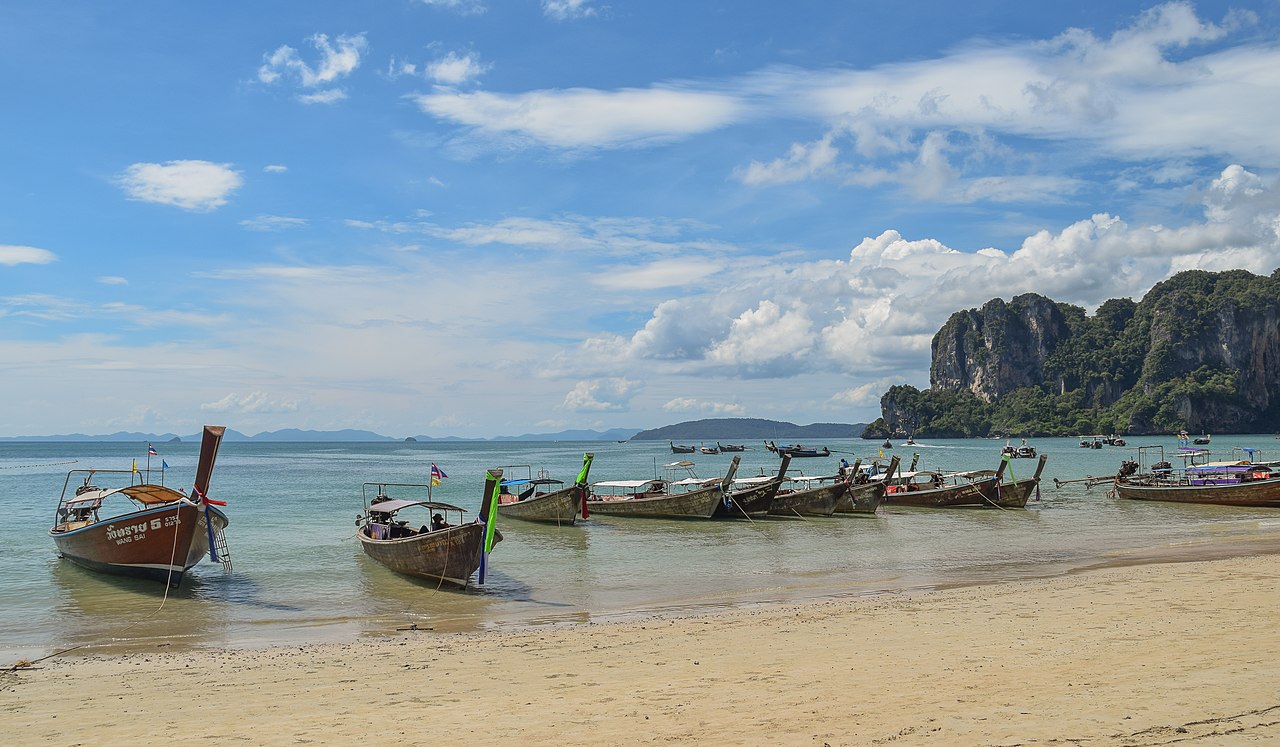
The Andaman coast on the west (Phuket, Krabi, Railay, Phi Phi, Koh Lanta, Koh Lipe and Khao Lak) is driest from November to April. From May the southwest monsoon brings rain and big waves, some boat trips stop, many Koh Lipe and Koh Lanta resorts close, and the Similan Islands national park shuts from 15 May to 15 October.
The Gulf of Thailand islands on the east (Koh Samui, Koh Phangan and Koh Tao) are sheltered from that monsoon, so they're the best beach choice from May to September. Their own wet season comes later, with the heaviest rain usually in November.
Unsure which side suits your dates? Our guide to choosing a Thai island compares both coasts island by island.
Tip: Travelling in July or August? Go to Koh Samui, Koh Phangan or Koh Tao rather than Phuket or Krabi. In November, it's the other way round.
The north's smoky season
Every year from about February to April, farmers in northern Thailand and neighbouring countries burn crop waste and forest undergrowth. Smoke sits in the valleys, hides the mountains and makes Chiang Mai one of the most polluted cities in the world for weeks: in March 2026 it was among the world's ten worst. Rain usually clears the air in late April or May.
If you have breathing problems, travel with children, or came for mountain views and trekking, plan the north for October to January instead. See Chiang Mai, Chiang Rai or Pai for how the north compares.
Festivals that change your trip
| Festival | When | What it means for you |
|---|---|---|
| New Year and Christmas | Late December to early January | The busiest and most expensive weeks of the year on the islands. Book months ahead. |
| Songkran (Thai New Year) | 13 to 15 April every year | A nationwide water fight, wildest in Chiang Mai and Bangkok. Fun, but transport and hotels are packed. |
| Loy Krathong and Yi Peng | Full moon in November: 24 November 2026 | Candlelit floats on rivers everywhere, and sky lanterns in Chiang Mai (23 to 25 November 2026). |
| Full Moon Party | Around each full moon | Haad Rin beach on Koh Phangan fills with tens of thousands of party goers. |
Dates for every year are in our Thailand festivals guide.
Weather by region
Average highs, lows and rainfall. Note how Phuket's wettest months (May to October) are Koh Samui's driest, and Samui's wettest (October to December) are Phuket's best.
Average daily high / low and monthly rainfall
| Month | Bangkokalso Ayutthaya and Kanchanaburi | Chiang Maithe north; nights are cool in winter | Phuketthe Andaman coast: Krabi, Phi Phi, Lanta | Koh Samuithe Gulf islands: Phangan and Tao |
|---|---|---|---|---|
| Jan | 32° / 22°15 mm | 29° / 14°5 mm | 32° / 23°30 mm | 29° / 24°150 mm |
| Feb | 33° / 24°25 mm | 32° / 15°8 mm | 33° / 24°20 mm | 30° / 24°50 mm |
| Mar | 34° / 25°40 mm | 35° / 19°15 mm | 33° / 24°50 mm | 31° / 25°60 mm |
| Apr | 35° / 26°80 mm | 36° / 22°50 mm | 33° / 25°130 mm | 32° / 25°75 mm |
| May | 34° / 26°220 mm | 34° / 23°160 mm | 32° / 25°290 mm | 33° / 26°160 mm |
| Jun | 33° / 26°160 mm | 32° / 24°130 mm | 31° / 25°260 mm | 32° / 25°130 mm |
| Jul | 33° / 25°170 mm | 31° / 23°160 mm | 31° / 25°270 mm | 32° / 25°140 mm |
| Aug | 32° / 25°220 mm | 31° / 23°220 mm | 31° / 24°270 mm | 32° / 25°160 mm |
| Sep | 32° / 25°330 mm | 31° / 23°200 mm | 30° / 24°370 mm | 32° / 25°130 mm |
| Oct | 32° / 24°240 mm | 31° / 21°110 mm | 31° / 24°310 mm | 31° / 24°290 mm |
| Nov | 32° / 23°50 mm | 30° / 18°40 mm | 31° / 24°180 mm | 30° / 24°530 mm |
| Dec | 31° / 21°10 mm | 28° / 15°15 mm | 31° / 23°60 mm | 29° / 24°260 mm |
Rounded long term averages. Blue shading marks the wetter months. Individual years can be hotter, colder or wetter.
Rather have a trip to Thailand made just for you?
Answer a few quick questions and a local specialist will send you a free, no-obligation itinerary and price.
Frequently asked questions
What is the best month to visit Thailand?
December to February is the most reliable for the whole country: dry on the Andaman coast, cool in the north, and the Gulf islands improving through December. February is a little quieter and cheaper than the Christmas peak.
Is Thailand worth visiting in the rainy season?
Yes, if you plan around it. Rain usually comes in heavy afternoon bursts, prices drop, and the Gulf islands (Koh Samui, Phangan and Tao) stay mostly dry from May to September.
When should I avoid Chiang Mai?
Late February to April, when smoke from crop burning often makes the air unhealthy and hides the mountains.
When is the cheapest time to visit Thailand?
May, June and September usually have the lowest prices for hotels and tours, apart from the Gulf islands, which stay popular through the summer.
Sources we checked
Thailand month by month
More Thailand guides

Thailand itineraries: 7, 10, 14 and 21 days that actually work
In 10 days, do Bangkok, Chiang Mai and one island area. In 14 days, add a second island or Khao Sok. A week is enough for Bangkok plus either the north or one island, not both. Pick the Andaman coast (Phuket, Krabi) from November to April and the Gulf islands (Samui, Phangan, Tao) from May to September.
Updated 6 November 2026
How much does a Thailand trip cost? Tours, budgets and a calculator
Doing it yourself, plan on about US$40 to 60 a day on a backpacker budget, US$90 to 150 mid range and US$250 or more for comfort, per person sharing. Group tours run about US$90 to 140 a day on 18 to 35 trips, US$140 to 220 on small group tours and US$300 or more for private or premium tours. Islands, peak season and internal flights push costs up.
Updated 6 November 2026
Which Thai island? The Andaman and Gulf islands compared
Choose your coast by month first: the Andaman side (Phuket, Krabi, Phi Phi, Lanta, Lipe) from November to April, the Gulf (Samui, Phangan, Tao) from January to August. Then choose by style: Phuket or Samui for easy flights and resorts, Krabi and Railay for limestone scenery, Phi Phi or Phangan for parties, Koh Lanta or Khao Lak for families, Koh Tao for diving, and Koh Lipe or Koh Yao Noi for quiet.
Updated 6 November 2026
Phuket vs Krabi vs Koh Samui: which is right for you?
Phuket has the most choice, nightlife and day trips; Krabi has the best scenery and a calmer feel; Koh Samui is the most polished resort island and the best of the three from May to September. Phuket and Krabi are best November to April. For families, Phuket's Kata and Karon or Krabi's Ao Nang; for couples, Railay or Samui; for nightlife, Phuket's Patong.
Updated 6 November 2026